GoHighLevel for healthcare: building the whole practice front office
GoHighLevel for healthcare is the front office around your EHR: it follows up every new-patient enquiry in seconds, logs calls, collects consent forms with e-signatures, syncs bookings from the EHR, sends reminders, recovers no-shows and brings patients back for repeat care. It fits practices and care providers drowning in calls, paperwork and manual follow-up. The GoHighLevel Experts builds it from $1,490, live in 2 to 4 weeks.
This page covers the whole practice build. The compliance side (HighLevel’s HIPAA add-on, the BAA and what they don’t cover) has its own page: our GoHighLevel HIPAA compliance guide.
Key takeaways
- GoHighLevel works around the EHR, not instead of it. The EHR keeps appointments and charts.
- Automate everything around the step your practice must do by hand, such as taking a consult fee on a live call.
- Sync only booked patients from the EHR, through a HIPAA-compliant connector such as Keragon.
- Paperwork, e-signing and fax can move into one system: CareStar Healthcare saves about 200 work hours a month.
- Service-based retention reminders are where repeat visits come from.
What does GoHighLevel do for a healthcare practice?
GoHighLevel gives a practice one system for every patient conversation before and after the visit. New enquiries from forms and calls get an instant reply and a call task, a pipeline shows where each patient is, forms are signed online, reminders branch by visit type, and retention messages follow the service a patient bought. HighLevel includes CRM pipelines, forms, booking calendars, workflows and calling in its plans (checked on gohighlevel.com).
GoHighLevel is not an EHR or practice-management system. Clinical notes, prescriptions and the appointment book of record stay where they are. In both of our healthcare builds, the EHR or the care team’s process stays the source of truth, and GoHighLevel handles the communication and admin around it. Med spas follow the same pattern, with more weight on ad leads, consult booking and rebooking; see GoHighLevel for med spas.
Where do practices lose time and patients?
Practices lose patients in slow follow-up and lose staff hours in paperwork. Our two healthcare clients show both sides.
- Dr. Sue Decotiis, a hormone and weight-loss practice in New York, gets about 40 new leads a week, roughly half from website forms and half from calls. Follow-up was a manual email and then a phone call. The website form attracted heavy spam, consent forms were PDFs patients had to print and sign, and a separate tool, SolutionReach, sent reminders and birthday texts.
- CareStar Healthcare, in Stockbridge, Georgia, had more than 20 staff handling documents, signatures and faxes across DocuSign and manual paperwork. Patient applications had no central tracking, so staff chased each one by hand and patients called in to ask where theirs stood.
The fix in each case wasn’t more software. It was one system with clear rules about who gets contacted, when, and what stops the messages.
What does a healthcare GoHighLevel build include?
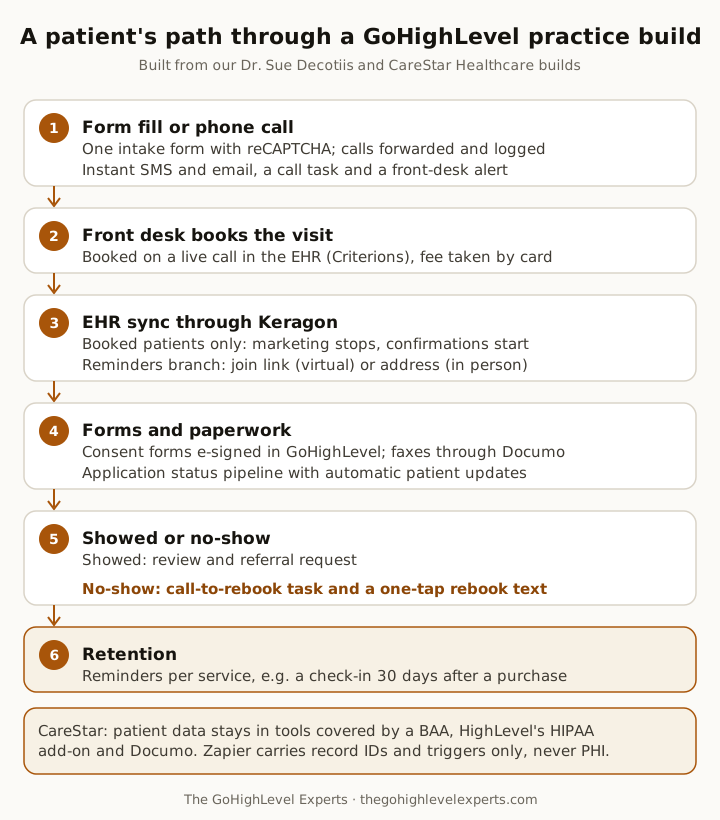
A healthcare build in GoHighLevel has six parts: speed-to-lead for forms and calls, a new-patient pipeline, online forms with e-signature, an EHR sync, reminders and no-show recovery, and retention. Document-heavy providers add fax automation and an application-status pipeline. This diagram combines both builds.
Speed-to-lead without changing how the front desk books
At Dr. Sue Decotiis’s practice, a consultation fee is taken by card on a live call, and doctor availability varies, so online self-scheduling was left out on purpose. GoHighLevel instead makes sure the call happens fast: a web form fill sends an instant SMS and email, creates a “call new lead” task and alerts the front desk. Inbound calls are forwarded to the office line and logged, and unknown numbers become new leads. Missed calls get a text-back and a callback task.
The phone setup started on day one with A2P 10DLC registration for texting, CNAM so the practice name shows as caller ID, and STIR/SHAKEN attestation to reduce “Spam Likely” labels. We handle that as part of the build or as a standalone A2P 10DLC registration.
A new-patient pipeline
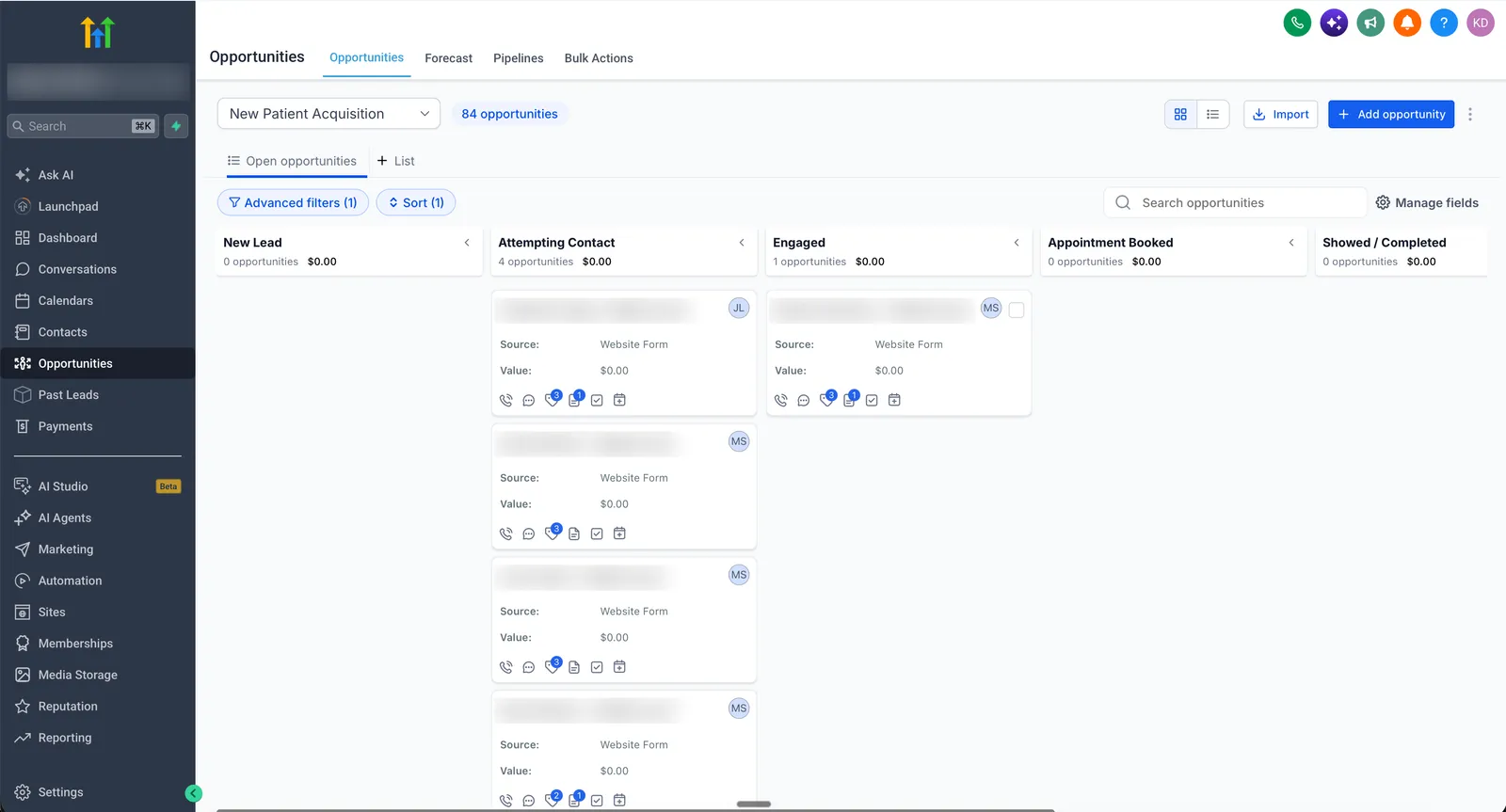
The practice’s pipeline has 7 stages: New Lead, Attempting Contact, Engaged, Appointment Booked, Showed / Completed, No-Show and Lost / Unresponsive. Workflows move patients between stages, and the front desk works the board visually.
Forms and e-signatures
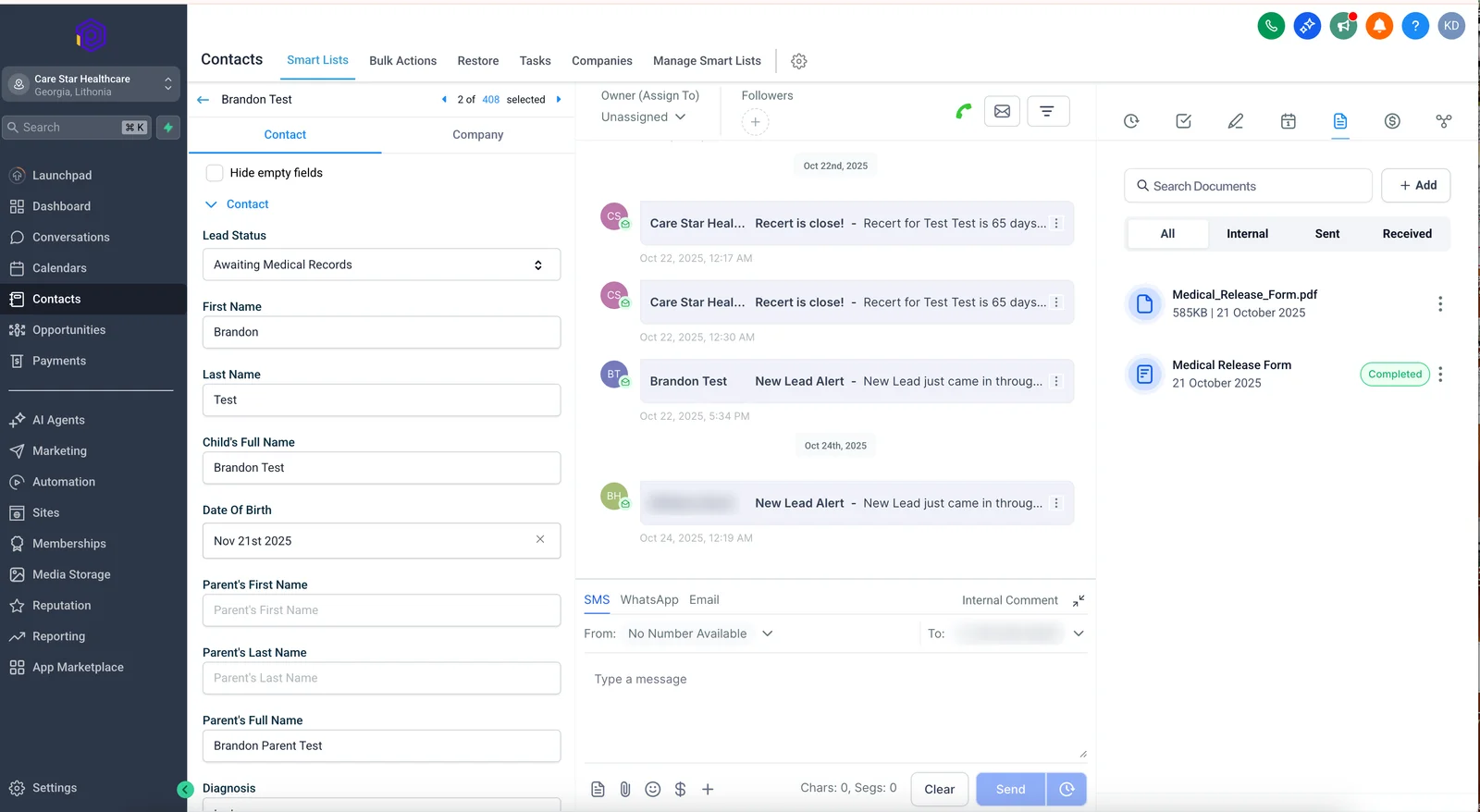
One intake form with reCAPTCHA replaced the spam-prone website form and asks for service interest and preferred contact method. Consent and authorization forms were rebuilt from PDFs as online forms with e-signature. At CareStar, a complete document-handling system with e-signing inside GoHighLevel replaced DocuSign.
The EHR sync
Keragon, a HIPAA-compliant integration platform built for healthcare, connects the Criterions EHR to GoHighLevel. Only booked patients sync across, not the whole lead list. The booking signal is what stops marketing messages and starts confirmations, so a patient who just booked never gets a “still interested?” text.
Reminders, no-shows and reviews
Reminders branch by appointment type: a join link for virtual visits, the address and parking for in-person ones. A no-show creates a “call to rebook” task and sends a one-tap rebook text; at this practice the fee is already paid, so the rebook is a courtesy. Completed visits trigger review and referral requests.
Retention that follows the service
Each service has its own retention cadence, such as a check-in 30 days after a peptide purchase. Birthday messages match what the old reminder tool sent, so the retention work SolutionReach did now runs in GoHighLevel.
Paperwork and fax automation
CareStar’s build moved patient documents and applications into GoHighLevel. Faxes are sent and received through Documo, a fax provider that also signs a BAA. Zapier only passes record IDs and triggers between the two, because Zapier isn’t HIPAA compliant. A pipeline tracks each patient’s application status, staff get alerts when a document needs action, and patients are updated automatically when their status changes.
What about HIPAA?
A practice that stores patient data in GoHighLevel needs HighLevel’s HIPAA add-on, which costs $297 a month, cannot be turned off once bought, and must be enabled in each sub-account (checked on help.gohighlevel.com). CareStar’s build runs on that add-on with a signed BAA. The rules that keep a build compliant after that are in the GoHighLevel HIPAA compliance guide.
What results have healthcare providers seen from GoHighLevel?
CareStar Healthcare saves about 200 work hours every month, measured on the live system, and replaced DocuSign with e-signing inside GoHighLevel. Dr. Sue Decotiis’s practice raised its show-up rate 21 percent, and its roughly 40 new leads a week are each followed up instantly.
CareStar’s Tech Coordinator, Brittany: “200 work hours saved each month. The automation transformed how we handle patient documentation.”
Read the full builds:
- CareStar Healthcare case study: paperwork, faxing and e-signing in one HIPAA-compliant GoHighLevel setup.
- Dr. Sue Decotiis case study: speed-to-lead, the Keragon EHR sync, nine workflows and retention reminders.
How much does GoHighLevel for healthcare cost, and how long does it take?
A healthcare build from The GoHighLevel Experts costs $1,490 to $5,500 at a fixed price and goes live in 2 to 4 weeks. EHR connections and document systems sit toward the top of that range, and we fix the price after mapping your workflow. Practices with an existing account can start with a $247 audit, credited against the build.
GoHighLevel Audit
$247
one-time · 48 hours
- Audit call: your setup, sales process and goals
- Detailed audit report: where leads and revenue leak
- Proposed fix with a fixed price
- $247 credited against the build
GoHighLevel Setup
$1,490–$5,500
one-time · 2–4 weeks
- Sales process mapped with you first
- Pipelines, calendars, forms and workflows
- Phone, A2P and email domain connected
- Training call, Loom walkthrough and PDF manual
- 6-month build guarantee
Support Retainer
From $247/mo
per month · Ongoing
- 4 hours of support a month
- Fixes, changes and new builds
- Rolling monthly: stop anytime
HighLevel bills you separately: plans start at $97 a month for Starter with 3 sub-accounts (checked on gohighlevel.com), plus the $297 HIPAA add-on if patient data lives in the account, plus usage for calls and texts. Tools like Keragon and Documo have their own subscriptions. Our GoHighLevel pricing guide covers the platform side, and the pricing page lists everything we charge. The build itself is described on the GoHighLevel setup and GoHighLevel automation pages.
When is GoHighLevel the wrong choice for healthcare?
GoHighLevel is the wrong choice when you want it to be the clinical system. It doesn’t replace an EHR, e-prescribing or practice-management software. If your problem is charting or billing, fix that first.
It is also a poor fit when:
- Your EHR’s patient engagement tools already cover it. If your EHR sends reminders, intake forms and recall messages and your team uses them well, GoHighLevel adds a second system to maintain.
- There’s no compliant route to your EHR. If your EHR can’t connect through a HIPAA-compliant platform, booked status has to be updated by hand, which removes much of the benefit.
- You won’t pay for HIPAA. The $297 add-on is a permanent monthly cost. Without it, patient data can’t go into the account, and a practice build without patient data is mostly a marketing tool.
- You want online self-booking but can’t support it. Dr. Sue Decotiis’s practice deliberately kept phone booking. If your schedule or payment process needs a person, build around that person.
Sources
- HighLevel, Pricing (checked )
- HighLevel help center, HIPAA Compliance With HighLevel (modified June 11, 2026) (checked )
- The GoHighLevel Experts, CareStar Healthcare case study and Dr. Sue Decotiis case study
- Zapier’s HIPAA position, summarized in our guide Is Zapier HIPAA compliant?
FAQ
Can a medical practice run its front office on GoHighLevel?
Yes, around the clinical system rather than instead of it. GoHighLevel can handle new-patient follow-up, calls, forms and e-signatures, reminders, no-show recovery, reviews and retention, while appointments and charts stay in the practice's EHR.
Can GoHighLevel connect to an EHR?
Often, through a HIPAA-compliant integration platform. For Dr. Sue Decotiis's practice, Keragon passes booked appointments from the Criterions EHR into GoHighLevel, which stops marketing to that patient and starts confirmations and reminders.
Can GoHighLevel replace DocuSign and manual faxing for a healthcare provider?
It did for CareStar Healthcare. Documents are e-signed inside GoHighLevel, and faxes go through Documo, a fax provider that signs a BAA. CareStar saves about 200 work hours a month on the live system.
How much does it cost to set up GoHighLevel for a healthcare practice?
The GoHighLevel Experts charges $1,490 to $5,500 at a fixed price, live in 2 to 4 weeks. HighLevel's plans start at $97 a month, and a practice storing patient data also needs HighLevel's HIPAA add-on at $297 a month, as of November 4, 2026.